You are preparing for an important event and urgently need precise lip definition. Suddenly, you realize your favorite lip crayon is completely blunt. To make matters worse, you lack a specialized makeup sharpener to fix it.
Resorting to improvised sharpening methods often destroys expensive makeup, splinters fragile casings, or snaps the delicate core. Worse still, using unsterilized tools introduces harmful bacteria to a highly sensitive facial area. You need a reliable, hygienic fix immediately to save your look.
This guide provides a pragmatic, risk-aware approach to restoring your product's tip using common household tools. We emphasize strict dermatological hygiene, formula preservation, and maximizing overall product longevity. You will learn exactly how to shape your makeup safely without compromising its quality or risking your health.
Key Takeaways
Improvised solutions require strict hygiene: Any makeshift tool must be sterilized with 70% isopropyl alcohol to prevent bacterial transfer.
Formula dictates the method: Wooden, plastic, and ultra-soft wax lip crayons each require distinct shaping approaches (cutting vs. freezing).
DIY is a short-term fix: Makeshift sharpening compromises product yield over time; investing in a dual-barrel cosmetic sharpener is the only scalable, long-term solution.
1. Framing the Problem: Why Standard Life Hacks Fail
Standard writing tools differ greatly from makeup pencils. They contain hard graphite cores encased in rigid wood. Conversely, a lip crayon relies on a delicate balance of lipids and waxes. These soft formulas melt upon contact. They require thicker barrels to support their fragile structure. Manufacturers often use composite materials or rigid plastics to protect the soft core.
Aggressive makeshift sharpening ruins your financial investment. You risk snapping the tip entirely. You might mangle the plastic casing beyond repair. A single bad attempt can waste up to 20 percent of a high-end product. Replacing damaged luxury makeup frequently drains your cosmetic budget. Poor technique leads to jagged edges. Jagged edges scratch the delicate skin surrounding your mouth.
Many people grab a standard office pencil sharpener in a panic. This constitutes a critical error. The blade angle targets hard wood and graphite. It aggressively shreds soft cosmetic waxes. Furthermore, office tools harbor severe cross-contamination risks. Graphite dust and stationary bacteria transfer directly to your skin. The delicate wax will also gum up the sharpener blades permanently. This ruins the office tool and destroys your makeup simultaneously.
2. Solution Categories: 3 Viable Methods for Shaping a Lip Crayon
You must choose your shaping method carefully based on the product formula. We outline three distinct approaches below. Each method serves a specific type of cosmetic casing and wax consistency.
Comparison of Improvised Shaping Methods
Method
Best For
Mechanism
Product Waste Level
A. Precision Blade
Wooden or composite casings
Manual whittling
High
B. Freeze-and-Pinch
Ultra-soft formulas, creamy balms
Temperature manipulation
None
C. Paper Friction
Minor touch-ups, rounded tips
Angle-based wearing
Low
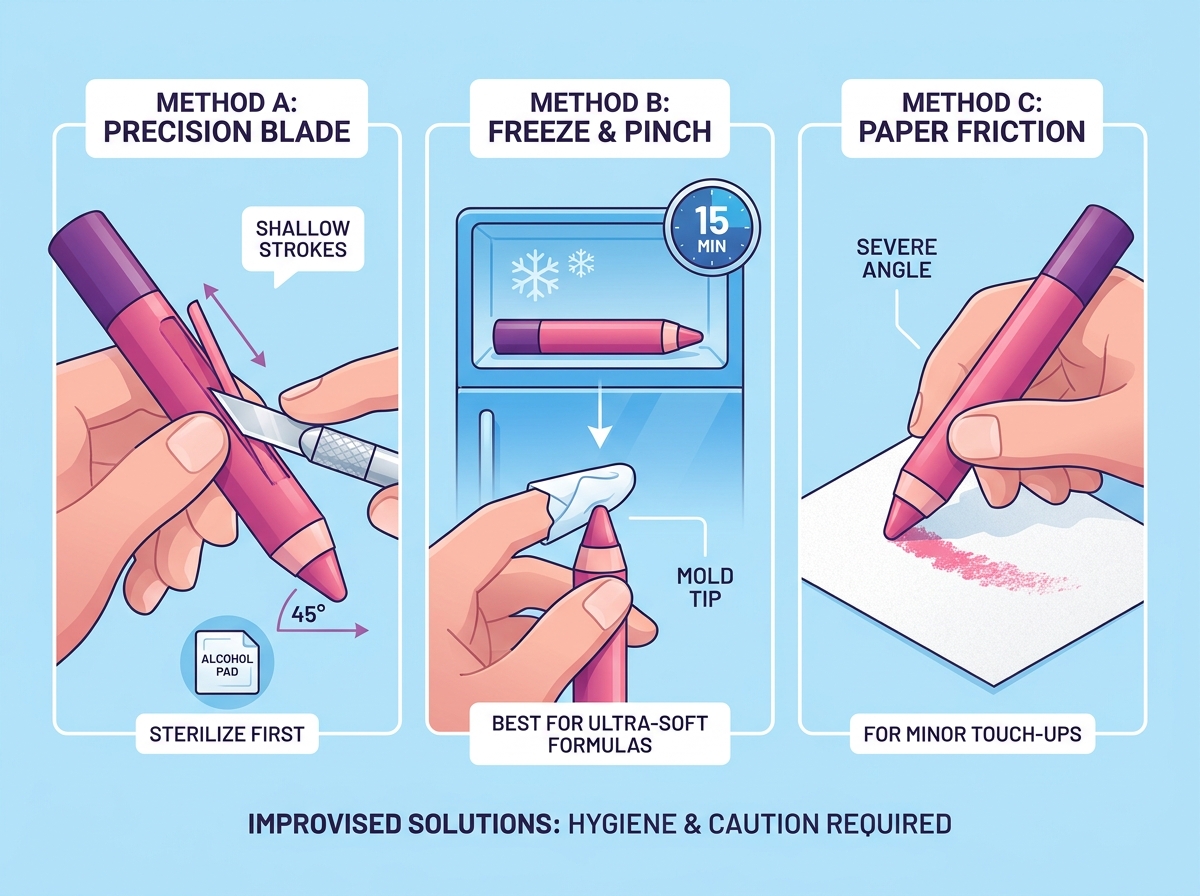
Method A: The Precision Blade Approach (Knives or Scissors)
This aggressive technique mirrors traditional whittling. It works best for traditional wooden or composite-cased products. You physically shave away the outer barrel to expose the inner core.
You need a sterilized craft knife, a sharp pocket knife, or a heavy-duty scissor blade. Dull blades will crush the barrel rather than slice it. You manually whittle the casing down. This exposes the fresh color underneath. You must exercise extreme caution to avoid physical injury. We recommend this only when you possess a highly stable surface.
Method B: The Freeze-and-Pinch (Temperature Manipulation)
Some formulas are entirely too soft for a blade. This method works best for ultra-soft formulas, creamy balms, or retractable sticks. Retractable tubes often lose their point after repeated applications.
You leverage temperature to change the physical state of the wax. Place the product in the freezer for exactly 15 minutes. This rapidly hardens the lipid structure. Remove the chilled product immediately. Wrap a clean, dry tissue around your index finger and thumb. Gently pinch the blunt end. Mold the tip back into a functional cone shape. The tissue acts as a hygienic barrier.
Method C: The Paper Friction Technique
Sometimes you only need a minor adjustment. This technique works best for minor touch-ups. It perfectly fixes a slightly rounded tip without requiring dangerous blades.
You utilize friction to reshape the wax. Find a rough piece of clean paper. Standard printer paper works well. Draw heavy lines at a severe, 45-degree angle. This naturally wears down the edges of the wax. You essentially create a temporary wedge shape. It provides enough precision for a single application. It avoids altering the physical casing entirely.
3. Evaluating Efficacy & Risks (Hygiene, Yield, and Safety)
Dermatological compliance remains your highest priority. The lips feature highly vascular tissue. The stratum corneum is exceptionally thin in this area. This makes your mouth highly susceptible to infection. You must absolutely sterilize any non-cosmetic blade before use. Dirty household tools harbor microscopic pathogens. Transferring staphylococcus bacteria from a pocket knife to your mouth invites severe dermatological complications.
You must also consider formula integrity. Temperature manipulation alters the physical properties of luxury formulations. Freezing temporarily affects the glide and emollience. The hardened waxes may feel stiff during the initial application. However, this change is not permanent. The ingredients stabilize rapidly. The product regains its creamy texture once it returns to room temperature.
Finally, weigh precision against product waste. You must evaluate which method serves your immediate needs best. The precision blade yields the sharpest possible line. Unfortunately, it sacrifices the highest amount of usable material. The freezing method sacrifices zero material. However, manual pinching rarely produces a razor-sharp edge. The paper friction method balances the two. It wastes minimal product while delivering acceptable temporary precision.
Proper preparation prevents disaster. You must gather all necessary supplies before altering your makeup. Improvising mid-process often leads to ruined products or physical injury.
Sanitary Barriers: Prepare clean, lint-free facial tissues to handle the exposed wax.
Appropriate Tool: Select a freshly cleaned, heavily sharpened blade or craft knife.
Workspace: Clear a highly stable, well-lit surface to prevent slipping.
Execution Protocol (Blade Method)
Following a strict physical protocol ensures safety. Rushing the whittling process guarantees a snapped core. Treat the lip crayon gently during this phase.
Positioning: Hold the barrel firmly in your non-dominant hand at a 45-degree angle toward the table.
Initial Cut: Place the sterilized blade about one centimeter down from the blunt tip.
Motion: Shave strictly away from your body. Use shallow, millimeter-deep strokes. Never force the blade deeply into the core.
Rotation: Rotate the barrel evenly after every single stroke. This prevents lopsided tips and uneven edges.
Refinement: Stop shaving immediately once the colored core exposes a functional edge.
Failure Mitigation & Salvage
Accidents happen despite careful planning. You might apply too much pressure. The tip may completely snap off during the shaving process. Do not discard the broken piece. You can easily salvage your investment.
First, sanitize a small, empty cosmetic sample pot. Carefully place the broken wax chunk inside. Use a hairdryer on a low heat setting to gently melt the wax. Once it liquefies, let it cool and set. You have now successfully transformed your broken pencil into a highly usable tinted balm. Apply it using a clean cosmetic brush.
5. Decision Logic: When to Stop DIYing and Upgrade
Improvised methods serve a specific, narrow purpose. We define the acceptable threshold for DIY shaping strictly. You should only use these hacks during travel emergencies. They also work for unexpected breakages right before an important event. They represent triage, not standard operating procedure.
You must eventually secure a long-term scalable solution. Purchasing a dedicated, dual-barrel cosmetic sharpener is mandatory. It acts as a low-cost investment for makeup hygiene. These specialized tools feature carbon steel blades set at precise angles. They effortlessly slice through soft cosmetic casings. They also include built-in cleaning picks. The pick removes waxy residue safely. This preserves your budget and prevents cross-contamination between different colored products.
Consider a complete product pivot if shaping causes constant frustration. Evaluate your daily cosmetic habits. It might be time to transition entirely away from sharpenable pencils. Auto-twist or retractable products bypass the sharpening requirement completely. They deliver consistent color without the maintenance overhead. You trade a slightly blunter application edge for ultimate convenience.
Conclusion
Safely shaping your makeup without specialized tools requires a deliberate, hygienic approach. You can restore functionality in an emergency. However, you must protect both yourself and the product formula simultaneously. Ignorance of basic sanitation leads to ruined cosmetics and potential skin infections.
We highly recommend using the precision blade or freeze method for immediate triage. Assess your casing type before proceeding. Ultimately, prioritize purchasing a sanitary, dual-barrel cosmetic sharpener. It remains the most effective way to maximize the lifespan of your expensive makeup collection.
Identify your product's casing material before selecting a shaping method.
Sterilize all household blades with 70% isopropyl alcohol prior to use.
Utilize the freeze-and-pinch technique for ultra-soft formulas to prevent waste.
Invest in a dedicated cosmetic sharpener to maintain long-term hygiene and product yield.
FAQ
Q: Can I use a regular school pencil sharpener on my lip crayon?
A: No. The blade angle is designed for hard graphite, not soft wax. It will destroy the product while introducing stationary bacteria directly to your lips. Office tools also jam permanently when exposed to cosmetic lipids.
Q: How do you sharpen a lip crayon that is made of plastic?
A: Plastic-encased products that do not twist up require high-grade cosmetic sharpeners. If using a knife, proceed with extreme caution. Plastic splinters unpredictably and can cause severe injury. Shave in very shallow increments.
Q: Will freezing my lip crayon ruin the formula permanently?
A: No. A brief 10 to 15-minute freeze only temporarily solidifies the waxes. This prevents breakage during manual shaping. The product will return to its normal creamy texture once it reaches room temperature again.
Guangzhou Vast Cosmetic Co.,Ltd. was established in 2018, a high-tech enterprise focusing on customizing make-up for customers, integrating scientific research, production, sales and service.